SAME DAY ESTIMATES AVAILABLE
CALL FOR A FREE ESTIMATE
(440) 457-7064
May 5, 2026
Choosing between timber and high-strength steel for your garage structure is a decision that dictates the next thirty years of your property’s maintenance schedule. While traditionalists cling to the familiarity of a stick-built garage, modern engineering has pushed prefabricated metal buildings into the forefront of residential construction. This choice isn’t merely about the “look” of the building, but rather the structural integrity and resistance to environmental degradation.
A well-researched decision requires looking past the surface to evaluate how each material handles load-bearing demands and long-term wear. The debate over garage construction materials often boils down to a trade-off between initial customization and lifetime durability. Wood framing offers a classic aesthetic that many homeowners find comforting, yet it remains vulnerable to moisture, fire, and pest infestations.
On the other hand, steel provides a storage solution that is mathematically precise, fire-resistant, and significantly faster to erect. Understanding the metal garage specifications versus wood framing standards is the first step in avoiding a costly mistake. By analyzing the data, it becomes clear that the “cheaper” initial option often hides high long-term costs.
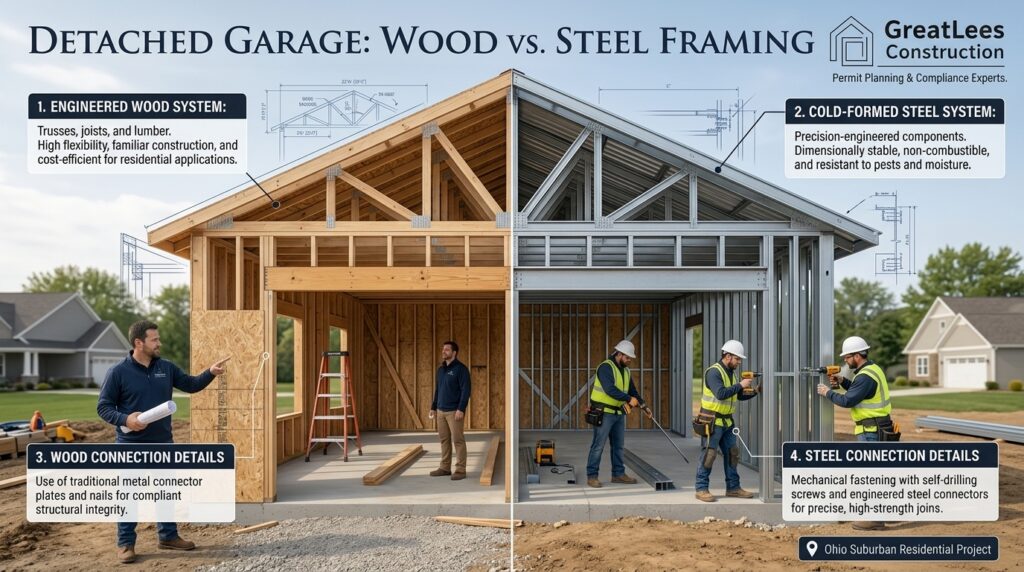
Steel framing involves the use of cold-formed, high-strength steel members to create the skeleton of the garage, offering a level of precision that organic materials cannot match. These prefabricated metal garages are engineered to exact tolerances, ensuring every corner is perfectly square and every load-bearing point is optimized for safety. In contrast, wood framing—or stick-built construction—relies on dimensional lumber that is cut and assembled on-site by skilled carpenters.
While wood allows for fluid design changes during the build, it is inherently prone to shrinking, warping, and crowning over time due to its organic nature. Steel components are treated to resist corrosion, whereas wood requires chemical treatments or siding to prevent rot and decay. Ultimately, the choice between these two determines whether your garage functions as a static asset or a high-maintenance liability.
The comparison between steel and wood is often framed as a battle between modern efficiency and old-world craftsmanship. Steel frames offer a superior strength-to-weight ratio, allowing for larger open spans without the need for interior support columns that clutter your storage solution. Wood is easier for the average DIY enthusiast to work with, but it lacks the dimensional stability required for high-wind or heavy-snow regions.
Furthermore, the environmental impact varies; steel is 100% recyclable, while wood is renewable but often requires toxic sealants for longevity. Choosing steel means investing in a structure that remains straight for decades, whereas wood will eventually settle and shift.
| Feature | Wood (Stick-built) | Steel (Prefabricated) | Winner | Impact on ROI |
| Durability | Vulnerable to rot/pests | Immune to biological threats | Steel | High |
| Fire Resistance | Combustible material | Non-combustible | Steel | Insurance Savings |
| Build Speed | 2–4 Weeks | 3–7 Days | Steel | Lower Labor Costs |
| Customization | High (On-site) | Moderate (Pre-planned) | Wood | Design Flexibility |
| Eco-Friendliness | Renewable Source | 100% Recyclable | Tie | Variable |
| Spanning Ability | Limited without beams | Superior long-span | Steel | More Floor Space |
| Maintenance | High (Paint/Treatment) | Very Low | Steel | Time Savings |
| Precision | Subject to human error | Laser-accurate factory cuts | Steel | Structural Integrity |
| Resale Value | Standard/Expected | Increasing Market Demand | Tie | Market Dependent |
When evaluating the financial layout, the metal garage cost per square foot typically undercuts wood by a significant margin due to reduced labor hours and material waste. While the raw price of high-strength steel can fluctuate, the efficiency of prefabricated garage units means you aren’t paying for weeks of on-site manual labor.
A wood garage cost is heavily weighted toward skilled tradesmen who must measure, cut, and nail every individual stud and rafter. Furthermore, long-term insurance premiums are often lower for steel structures because they are non-combustible and wind-rated. You must look beyond the quote and consider the “total cost of ownership,” including future repairs and pest control.
Prefabricated systems eliminate the guesswork and material waste associated with traditional building sites. By using computerized manufacturing, these units ensure that every bolt hole aligns perfectly, which slashes the assembly time and reduces overhead. This industrial approach allows for a more predictable budget, as most costs are locked in at the time of the order.
A custom garage built with wood allows for intricate architectural details that might be difficult to achieve with standard steel kits. If your goal is to match a historical home’s unique roofline or siding, wood provides the malleability required for high-end aesthetic matching. However, this flexibility comes at a premium price point that often exceeds the functional value of the building.
For a detached garage, steel is often the more pragmatic choice because it provides a standalone, rugged shell that requires zero attention. These structures are ideal for workshops or heavy equipment storage where the interior finish is less important than the structural “muscle.” Choosing steel for a detached unit ensures that your tools and vehicles are protected by a shell that won’t warp or leak.
Connecting a garage to your home often necessitates wood framing to ensure the expansion joints and roof ties integrate seamlessly with the existing structure. While an attached vs. detached garage comparison usually favors wood for integration, the detached metal option remains the king of cost-effectiveness. If your budget is the primary driver, a detached steel building is the most logical path forward.
Before breaking ground, you must evaluate the long-term environmental stressors and local building codes that will impact your structure’s lifespan. A Custom Garage requires more than just a floor plan; it demands a choice in material that aligns with your specific climate and intended usage. If you live in a high-moisture area, the organic nature of wood becomes a ticking clock of maintenance and potential rot.
Conversely, Metal garage specifications must be scrutinized to ensure the gauge of the steel is sufficient for local wind or snow load requirements. Failing to account for these variables during the planning phase will lead to structural failure or costly retrofitting down the road.
Utilizing high-strength steel ensures that your garage remains structurally sound without the risk of warping or bowing over time. Unlike wood, steel does not expand and contract significantly with temperature changes, preserving the alignment of doors and windows.
This stability makes it an ideal storage solution for heavy machinery or valuable vehicles that require a secure environment. Furthermore, the galvanized coating on modern steel frames provides a permanent barrier against rust and corrosion.
A wood garage cost is often justified by the unparalleled aesthetic flexibility it provides to homeowners who want a specific look. Wood allows for easy installation of traditional siding, decorative trim, and complex rooflines that match the primary residence perfectly.
While customization options exist for metal, wood remains the standard for those prioritizing architectural harmony over industrial efficiency. However, you must be prepared to pay the premium for the specialized labor required to execute these designs.
Investing in prefabricated garage units is the fastest way to add value to your property without the headache of a prolonged construction site. These kits are engineered for rapid assembly, meaning your “construction zone” is cleaned up in a matter of days rather than months.
Because the parts are manufactured in a controlled factory setting, the margin for error is nearly zero compared to on-site wood cutting. This precision ensures that the final product meets all safety standards while keeping the project on a strict timeline.
The comparison between these two framing materials is a battle between traditional craftsmanship and modern structural engineering. Wood framing remains the standard for an attached vs. detached garage because it allows for seamless integration with the existing home’s architecture and roofline.
However, the organic nature of timber means it is constantly at war with the environment, facing threats from moisture, fire, and wood-boring insects. High-strength steel removes these liabilities from the equation, offering a non-combustible and dimensionally stable skeleton that will not warp over time.
Is it Cheaper to Build a Garage out of Wood or Steel?
The financial comparison between wood and steel is often misunderstood by homeowners who only look at the price of raw materials rather than the total project cost. When you calculate the metal garage cost per square foot, steel consistently emerges as the more economical choice because it requires significantly fewer labor hours to assemble. A wood garage cost is inflated by the need for skilled carpenters who must spend weeks measuring, cutting, and framing the structure on-site.
Furthermore, prefabricated garage units minimize material waste, ensuring that you aren’t paying for scrap lumber that ends up in a dumpster. In contrast, a stick-built garage involves unpredictable expenses related to lumber grade fluctuations and extended construction timelines.
The “better” choice depends entirely on whether you value structural performance or architectural tradition, but from an engineering standpoint, steel is the superior material. Prefab metal buildings offer a level of resilience against fire, wind, and seismic activity that wood simply cannot match without massive, expensive reinforcements.
While wood might look better in a historic neighborhood, it represents a constant cycle of painting, sealing, and repairing that steel owners never have to face. In a world where time is a finite resource, the low-maintenance profile of a customized metal garage makes it a more logical long-term asset for the modern homeowner.
When reviewing metal garage specifications, it is vital to focus on the steel gauge and the quality of the protective coatings. Higher-quality kits use 12-gauge or 14-gauge steel, which provides the necessary rigidity to support heavy garage doors and overhead storage.
These specifications ensure that your building is not just a temporary shelter, but a permanent addition to your property’s infrastructure. Investing in top-tier specs now prevents structural sag and roof leaks a decade into the future.
Choosing a detached garage made of steel often results in a higher return on investment because of the building’s longevity and lack of upkeep. Future buyers value the “set it and forget it” nature of metal buildings, knowing they won’t have to deal with termite damage or wood rot.
While the initial appearance might be more industrial, the functional benefits of a clean, dry, and fire-safe space are universal selling points. Ultimately, your choice should reflect the reality that a garage is a tool for protection, not just a design statement.
Deciding between wood and steel framing is ultimately a choice between immediate aesthetic gratification and long-term structural resilience. While wood offers a traditional look that integrates well with residential architecture, it demands a lifetime of vigilance against rot, fire, and pests. Modern high-strength steel provides a superior alternative for those seeking a maintenance-free storage solution that withstands extreme environmental pressures.
By prioritizing engineered precision over organic variability, you ensure that your investment remains a durable asset rather than a depreciating liability. From a financial perspective, the lower metal garage cost per square foot and the speed of prefabricated garage units make steel the pragmatic winner for most homeowners.
The total cost of ownership for a wood garage often spirals due to ongoing labor-intensive repairs and higher insurance premiums. Choosing a customized metal garage allows you to enjoy modern efficiency without sacrificing the utility or value of your property. Ultimately, investing in a steel-framed structure provides the peace of mind that comes with knowing your garage is built to last for decades.
1. Does a steel garage affect Wi-Fi or cell phone reception inside the structure?
While the dense metal shell can slightly attenuate signals, installing a simple signal booster or a dedicated Wi-Fi access point easily resolves any connectivity issues. Unlike wood, which allows signals to pass more freely, steel provides a far more secure shield against external electronic interference and lightning.
2. Can I install solar panels on a metal garage roof compared to a wood one?
Steel garages are exceptionally well-suited for solar installations because their high-strength frames can easily support the additional weight of mounting racks. Furthermore, standing seam metal roofs allow for “non-penetrating” solar clips, which eliminate the risk of leaks that often occur with wood-and-shingle roof penetrations.
3. How does the foundation requirement differ between wood and steel garages?
Steel garages typically require a specific concrete slab with reinforced, thickened edges to anchor the high-strength steel base rails securely. While wood garages can sometimes sit on simpler pier-and-beam foundations, the precision of a metal structure ensures a perfectly level surface that prevents structural settling.
4. Will a metal garage be louder than a wood garage during heavy rain or hail?
Modern metal garage specifications often include advanced insulation and high-quality vapor barriers that dampen sound effectively, making the noise difference negligible. Without these treatments, a wood garage is naturally quieter, but adding simple spray foam to a steel unit provides superior soundproofing and thermal control.
5. Are there specific zoning laws that favor one material over the other?
Some local homeowner associations (HOAs) have strict mandates regarding exterior aesthetics that may require a metal garage to be finished with specific siding to mimic a traditional wood look. You should always verify local codes, though many modern prefabricated metal buildings now offer customization options that meet or exceed the most stringent residential zoning requirements.

Veteran Owned & Operated Since 2017
4.1 Average Rating (31 Reviews)
17601 W 130th St Suite #4
North Royalton, OH 44133
Monday - Friday: 8:00 AM - 5:00PM